If you’ve ever been on a roller coaster—the Cyclone on Coney Island, Valley Fair’s Wild Thing, the Matterhorn at Disneyland—you’ve probably experienced that heady mix of exhilaration and terror, followed by relief when the ride is finally over. You might even want to go again, knowing that you’ll end up back where you started.
Not so with the roller coaster of health crises, said Jackie Guetzko, DNP, APRN, CNP, Lifespark Director, Experience Services. “The current health care system puts seniors on a roller coaster that doesn’t end well,” she said. “We’ve made the hospital the default for any and all urgent needs; we incentivize older adults to see all the specialists; and we prescribe more and more medications—without regard for the individual’s preferences or personal goals.”
This cycle of emergency room visits, hospitalizations, and transitional care stays take a toll, gradually robbing seniors of their independence and ability to live life on their terms. “We don’t stop to ask, ‘Do you want to get off this roller coaster?’” Jackie said. “Instead, we continue to pursue aggressive treatments, even when these interventions won’t positively change the person’s health outcomes.”
An environment conducive to care
Trained as a nurse practitioner and board certified in adult and gerontological care, Jackie spent many years working in internal medicine, hospice, and palliative care before joining Lifespark in 2022. “We’ve known for a long time that our country’s health care system wasn’t prepared to support an aging population, and yet, nothing changed,” she said.
The one exception was the creation of additional educational opportunities for nurses to advance their credentials. Intentional or not, Jackie said that these programs allowed nurses to develop the skills and knowledge needed to practice more autonomously and in collaboration with their physician colleagues.
This, in turn, has made it possible for Lifespark to bring its model of complete senior health to more clients than ever before, reducing the number of unnecessary emergency room visits and hospital stays and helping older adults stay off the roller coaster of health care crises.
“We’re creating a space for people to get the care they need in the place they’re most comfortable—usually in their home,” she said. “By bringing services and support to our clients, we start to build a trusting environment where they can speak more openly about what they want, what’s important to them, and how they hope to live out the rest of their lives.”
Accountability for outcomes
Unlike the fee-for-service model, which rewards health care providers and hospitals for the volume of services they perform, Lifespark follows a value-based care model, which incentivizes the company for quality rather than quantity of care it delivers.
“Because we’re accountable for our clients’ health outcomes, our interventions are less about prescribing a drug or writing a referral, and more about delivering health education, having meaningful discussions on goals of care and advanced care planning, and helping people navigate logistics,” Jackie said.
In fact, as people age, the logistics of health care can become overwhelming. “Between choosing the Medicare plan that meets your needs, finding caregiving support, arranging transportation, and dealing with insurance and pharmacy benefits, it’s incredibly helpful to have a team that has your back,” she said. “Once our clients experience that level of support, they realize they can live longer, healthier lives by staying out of the hospital and in their homes with their loved ones.”
Managing her COPD at home
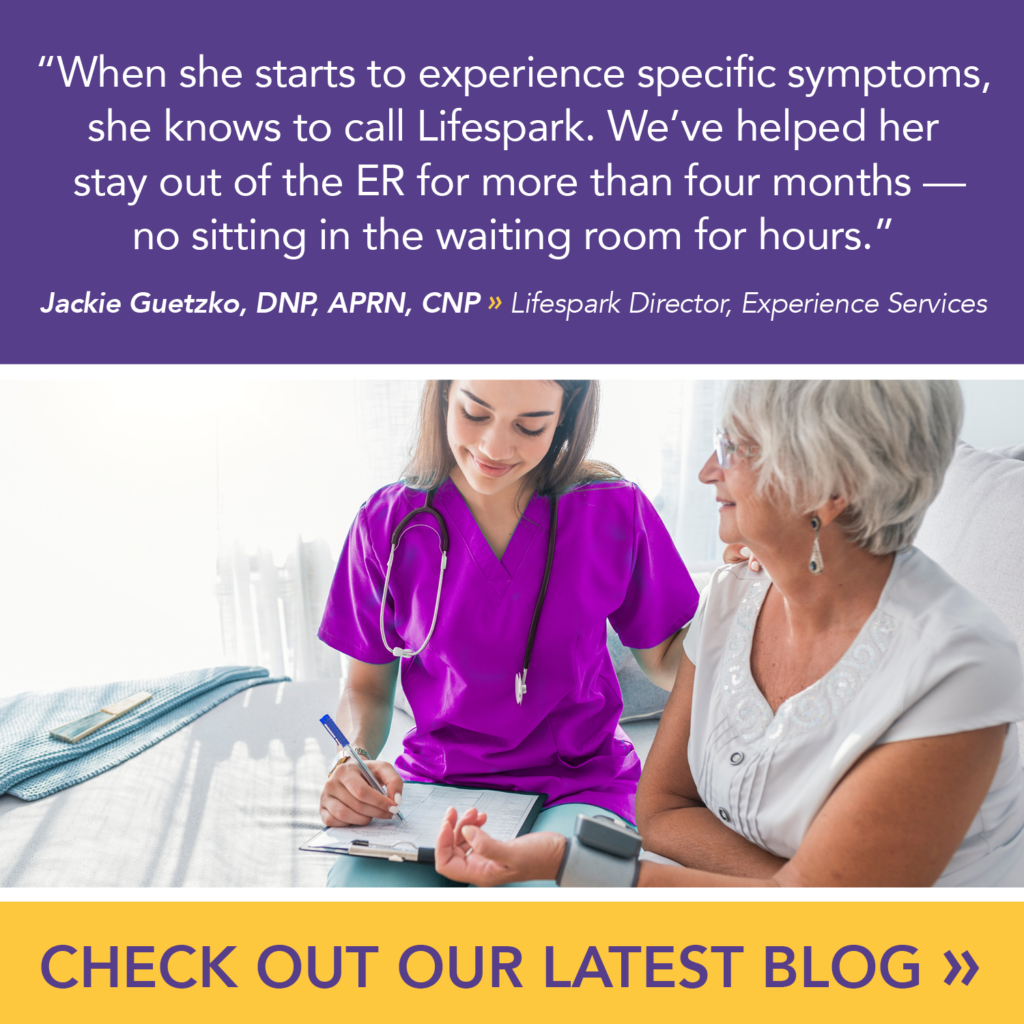
Jackie shared a story about a client with advanced chronic obstructive pulmonary disease (COPD) who, before finding Lifespark, went to the ER or urgent care every time she had a flare-up. Now, through a close partnership with the Life Manager and her provider, she has a contingency plan to activate orders for a nebulizer, prednisone, and antibiotics at her pharmacy.
“When she starts to experience specific symptoms, she knows to call Lifespark so her team can initiate the plan. As result, she hasn’t been to the ER in over four months,” Jackie said, adding that the client also appreciates not having to sit in the waiting room for hours or put herself at the mercy of the health care system.
With ongoing reinforcement from the Life Manager and a fully coordinated team approach, the client has developed a high level of trust in the plan and feels empowered to manage her care. Best of all, she’s no longer on that endless roller coaster ride.
To learn how Lifespark can help you or a loved one avoid unnecessary hospitalizations—and age more magnificently—visit Lifespark.com.