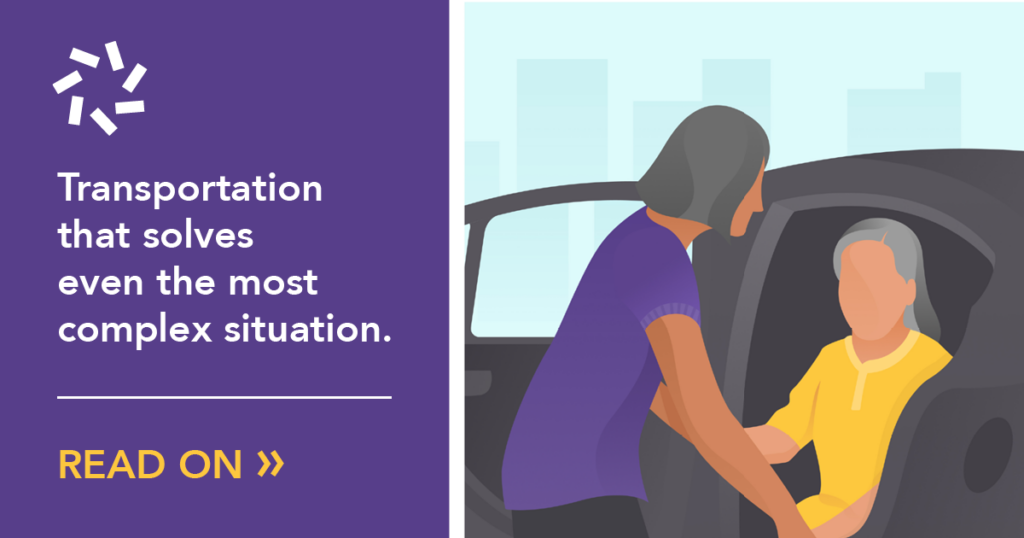
When seniors come home from the hospital or transitional care unit (TCU), transportation is often an issue. Especially if you need a stretcher which requires a specialty vehicle and a two-person assist. For those with more complex needs, if your transportation is not equipped to meet them, you may be required to stay in the hospital or TCU longer.
That challenge inspired K.C. Kanaan, CEO of Envoy America, who works in partnership with Lifespark to offer Lifespark GO! Transportation services. The solution – incorporate the Broda chair into its transportation service offerings.
“When the doctor says you’re ready to go home, you don’t want to wait; you just want to go home,” said K.C. Knowing that for some, the traditional transportation wouldn’t work, K.C.’s worked with his team to create a solution that optimized the whole experience from your typical transport to those with more challenging situations like a stretcher. “We kept thinking and researching and found the Broda chair as an opportunity to fill this gap, so we decided to make the investment.”
A Broda chair is a specialized, durable medical equipment chair designed for individuals with mobility challenges who need long-term seating support. These chairs are distinct from standard chairs and are engineered with advanced features like tilt-in-space technology and customizable adjustments to promote proper posture, reduce pressure sore risk, and provide comfort for people with conditions like ALS, Parkinson’s, or MS.
The secret is its unique design. The challenge with a regular stretcher is that one person can’t operate it alone. If someone needs transportation involving a stretcher, they not only have to wait for a specialty vehicle to be available, but for two individuals as well. One to drive and the other to assist them with the stretcher.
The Broda chair changes that; it’s designed to be operated by one person. The Broda chair is unique because it can act as a wheelchair, and it can act as a stretcher. It’s something that is comfortable for the senior in need of transportation.
“It’s also very safe,” said K.C. “The investment in a Broda Chair helps the Lifespark team accelerate the transitions and admissions processes for seniors. What seems like a small solution has created major impacts in efficiency of transportation in Twin Cities health care, and a higher level of service to the residents and seniors in Lifespark communities
Broda chairs cost $8,000 and $9,000 but according to K.C., it doesn’t cost more for a senior to use the Broda chair option with Lifespark GO. Other general transportation providers charge a base rate to pick up a senior, which can range between $35 and $80 depending on distance. Then there are often upcharges based on extra miles, if the senior has special needs such as bariatric or oxygen needs, if they bring a caregiver, or if they bring luggage.
Lifespark GO simplifies everything into one charge based on an hourly rate. “There’s no nickel and diming,” he emphasized. “There is no extra charge if you need to change your reservation, bring luggage or a caregiver. It’s just one hourly rate with great service that tends to be less expensive than anything else in today’s industry, using the latest technology like the Broda chair, and other things to make it easier, better, and faster.”
As K.C. sees it, investments like the Broda chair make a difference on many levels. “When hospitals can’t discharge people on time, it costs them money, and new people can’t be admitted,” explained K.C. “Lifespark GO with the Broda chair creates new options for timely discharge.”
Lifepark GO in partnership with Envoy America
Lifespark began partnering with Envoy America to outsource all their transportation in 2018. Called Lifespark GO, the partnership offers innovative accompanied transportation services along with a transportation bus that travels between the Lifespark senior living communities.
Lifespark GO gives seniors their independence when it comes to transportation, not just for medical appointments, but also for social events, community centers, playing cards, or even grocery shopping. Vehicles are equipped with dash cams and telematics that monitor speed and can tell if the driver is on the phone. Their companion drivers provide companionship, walking to and from the door with the senior, as well as waiting at appointments.