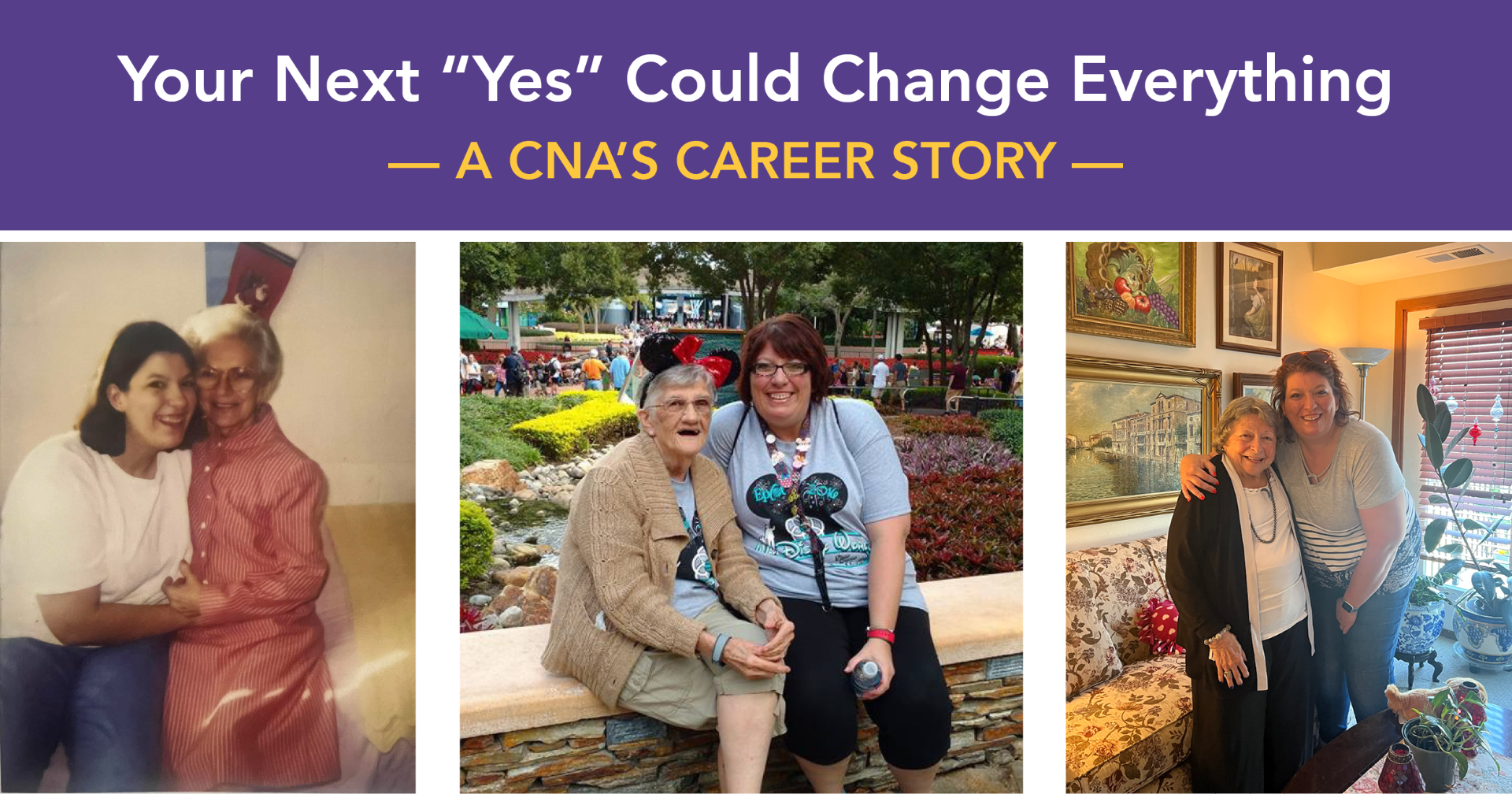
Angie McAllister was three years into a college degree to become an art teacher when she took a semester off from school.
Something about the path she was on didn’t feel right. Hoping to gain some clarity, she planned to work for a semester, then return to finish her degree.
Instead, she found herself applying for a CNA (Certified Nursing Assistant) position at her local senior living community. Because of her close relationship with her grandmother, she’d always felt drawn to older adults, and the community was hiring.
It was supposed to be temporary.
Thirty years later, Angie is the Senior Director of Joyful Living and Community Well-Being at Lifespark. But that title isn’t where her story starts. It starts at the bedside; in the work she did as a CNA—the same work CNAs and Home Health Aides (HHAs) do every time they show up for a resident.
What the Job Teaches You
Angie began as an overnight CNA before moving to day shifts. It was there, working alongside other CNAs, that she began to understand what the role could really be: building relationships, learning residents’ stories, and understanding just how much impact one caregiver can have on someone’s quality of life.
One resident, in particular, shaped how she saw work.
The community was planning a fishing trip and picnic. A resident with paralysis on one side wanted to go but wasn’t sure if he had the proper physical strength. Angie worked with him on his balance and mobility, day after day, helping him build the strength and confidence to make the trip.
He went.
To some, it might have looked like a small thing. To him, it meant reclaiming a piece of who he’d always been: someone who loved being outdoors. A few months later, he rolled into Angie’s office with something in his lap: a rolling pin he’d carved for her by hand. It was his way of saying thank you—and a reminder that helping someone rediscover what they’re capable of can ripple far beyond a single afternoon.
The First “Yes”
Angie loved direct care, but an opportunity was on its way—and it looked like something that shows up for CNAs and HHAs every day, if they’re paying attention.
Restorative nursing was becoming more common in senior living communities at the time. Because of her passion for helping residents build strength and independence, her administrator asked her to help launch the community’s restorative nursing program.
She said yes.
The role let her work alongside the therapy team, picking up where formal therapy sessions left off. It wasn’t technically a promotion; it was someone noticing what she was good at and asking her to do more of it.
Not long after, her administrator presented her with a bigger opportunity: to become an Activities Director.
Angie said no… at first. She genuinely loved what she was already doing. But her administrator and other coworkers encouraged her—they’d seen something in Angie before Angie saw it in herself.
Eventually, Angie agreed on one condition: if it didn’t work out after 90 days, she could go back to her old role. She never needed to.
Saying Yes, Again and Again
As Activities Director, Angie started asking different questions. Not just what activities should we plan, but how do we make them more personal? How do we build experiences that mean something to the people living here?
Word got around about her approach, and a community about an hour away started calling to ask about her ideas, eventually inviting her to tour (and apply for a role). During the visit, a resident asked, “Have you come here to make us smile?”
“Yes,” Angie said.
She took the job that same day.
The next 16 years created many opportunities to say ‘yes,’—from a regional role, then a divisional one, and eventually to leading community life programs for an entire organization. After the COVID-19 pandemic, she earned her long-term care administrator’s license and went back to lead at the community level again, because she wanted to be reminded of what change looks like up close.
Along the way, she connected with Eden Alternative, a non-profit focused on eliminating loneliness, helplessness, and boredom in long-term care. Its founder, who was also Lifespark’s Chief Independence Officer, Dr. Bill Thomas, mentioned that Lifespark was hiring a Senior Director of Joyful Living and Community Well-Being and asked if she’d consider it. Once again, Angie said yes.
Advice to CNAs: Your Next “Yes” Might Look Different, and That’s Okay
Angie recognizes that not every CNA or HHA who says yes to a new opportunity ends up leading a national program. But the door exists—and it opens more often than people expect. She encourages those starting their careers in these roles to consider what saying “yes” might lead to. From where she sits, doing so can help you:
- Become a restorative aide, helping residents build strength and independence alongside therapy
- Step into an activities or life enrichment role, shaping how residents spend their days
- Train or mentor new CNAs and HHAs coming up behind you
- Move into scheduling, care coordination, or team lead roles
- Pursue a license or certification—like Angie’s long-term care administrator credential—while working
- Simply stay at the bedside and become the person new hires learn from
None of these require knowing your whole career path in advance. Angie didn’t have one. She just kept saying yes to the next thing in front of her.
“Walk in and explore what your options are,” she says. “Sometimes our own confidence holds us back from exploring what other opportunities could be out there for us.”
She’s quick to remind CNAs and HHAs not to box themselves in.
“There are so many different options available. It’s about figuring out where you fit, what you’re passionate about, and what you want to try,” said Angie.
And most of all, she wants caregivers to recognize the weight of the work they’re already doing, whether they ever take on a new title. “CNAs have some of the strongest relationships with seniors. That’s something to be proud of, to remember, and to be confident in.”
If you’re a CNA or HHA today, you’re already doing the part of the story that matters most. What comes next is up to you. It might start with something as small as saying yes the next time someone asks. Ready to say yes? If you are, we’re hiring.